
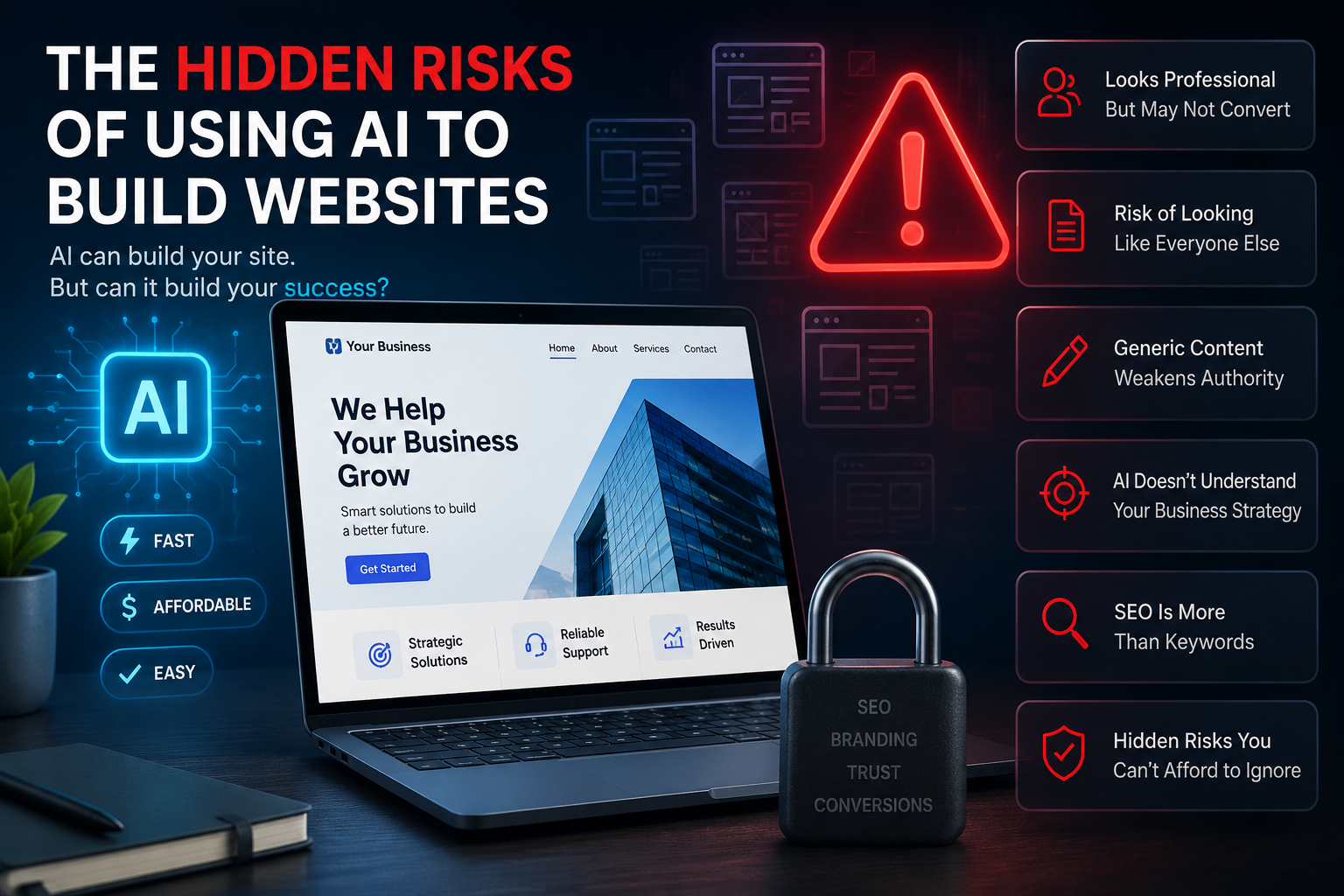
Artificial Intelligence has transformed website development in ways few businesses imagined just a few years ago. Today, a business can describe its services, choose a preferred style, and generate an entire website within minutes. AI website builders promise faster development, lower costs, and an easier way to establish an online presence.
For startups and small businesses, the appeal is obvious. Why spend weeks working with a designer and developer when AI can generate a professional-looking website in a fraction of the time?
The speed is impressive, but speed alone doesn’t determine whether a website will help a business grow.
A website is more than a digital brochure. It is often the first interaction customers have with your business. It influences how people perceive your brand, whether they trust your services, and ultimately whether they decide to contact you or move on to a competitor.
This is where many businesses make a costly mistake.
They assume that because AI can build a website, it can also build a successful online presence.
In reality, AI is an excellent tool for accelerating development, but it cannot replace the strategic thinking required to create a website that builds trust, supports business goals, and generates consistent results.
Understanding the risks doesn’t mean businesses should avoid AI. It means they should understand where AI adds value and where human expertise still plays a critical role.
A Website Can Look Professional Without Being Effective
One of the biggest misconceptions about AI-generated websites is that good design automatically leads to good performance.
Most AI website builders are capable of producing clean layouts, modern typography, and attractive color schemes. At first glance, these websites often look impressive.
However, a successful business website is not judged by appearance alone.
Its real purpose is to guide visitors toward taking action, whether that’s requesting a quote, booking a consultation, purchasing a product, or contacting the business.
AI can arrange design elements, but it doesn’t fully understand customer psychology, buying behaviour, or the unique journey your audience takes before making a decision.
Without a clear conversion strategy, businesses often end up with websites that look polished but struggle to generate enquiries or sales.
The Risk of Looking Like Everyone Else
AI learns from existing data, design patterns, and commonly used layouts. While this allows it to generate websites quickly, it also creates a hidden challenge.
Many AI-generated websites begin to look remarkably similar.
- The homepage structure.
- The service sections.
- The calls-to-action.
Even the wording often follows familiar patterns.
When businesses in the same industry rely on similar AI tools, their websites start resembling one another.
This creates a branding problem.
If your website looks and sounds like every competitor’s website, visitors have very little reason to remember your business.
Strong brands stand out because they communicate a unique identity, not because they use the latest technology.
Generic Content Weakens Your Authority
Content is one of the strongest assets a business can have, but only when it reflects genuine expertise.
AI can generate service pages and blog posts within seconds, yet much of this content is based on patterns already available online.
It often explains what a service is without demonstrating why your business is the right choice.
Customers today are looking for evidence, not just information.
They want to understand how you’ve solved similar problems, what makes your approach different, and why they should trust your experience.
If your content sounds identical to dozens of other websites, it becomes difficult to establish authority.
Search engines and AI platforms are also becoming better at recognising original, experience-based content.
Businesses that rely entirely on generic AI-generated copy risk losing one of their biggest competitive advantages: authenticity.
AI Doesn’t Understand Your Business Strategy
Every successful business has different goals.
Some websites are designed to generate leads.
Others focus on selling products, booking appointments, educating customers, or building brand awareness.
AI can generate pages based on prompts, but it doesn’t understand your long-term business objectives.
It cannot decide which services should receive greater emphasis, how your customer journey should be structured, or what messaging will resonate most with your audience.
These decisions require business knowledge, market understanding, and strategic thinking.
Without that strategy, businesses often launch websites that function technically but fail commercially.
SEO Is More Than Keywords
Many AI website builders advertise themselves as SEO-friendly.
While they often generate titles, headings, and basic metadata, modern SEO involves much more than automated optimisation.
Search engines increasingly reward websites that demonstrate originality, expertise, and value.
At the same time, AI-powered search is changing how businesses are discovered online.
Users are no longer relying solely on Google. They are asking ChatGPT, Gemini, Claude, and other AI platforms for recommendations.
This shift has introduced two concepts businesses cannot afford to ignore: E-E-A-T and Generative Engine Optimisation (GEO).
E-E-A-T, Experience, Expertise, Authoritativeness, and Trustworthiness, helps search engines and AI systems evaluate whether your business deserves to be considered a reliable source.
GEO focuses on improving a brand’s visibility within AI-generated answers.
Neither of these can be achieved simply by generating a website with AI.
They require genuine expertise, original content, strong brand authority, and a consistent reputation across the web.
Hidden Risks Businesses Often Discover Too Late
The biggest risks of AI website development rarely appear on launch day.
They appear months later.
Businesses begin noticing that visitors leave quickly without making contact.
Their content struggles to rank against competitors.
Their brand feels generic compared to others in the market.
Potential customers don’t immediately understand what makes the business different.
As the company grows, new functionality becomes difficult to integrate because the original website wasn’t planned with scalability in mind.
Eventually, many businesses invest additional time and money redesigning pages, rewriting content, improving SEO, and rebuilding parts of the website that could have been planned correctly from the beginning.
The initial savings often become long-term costs.
The Best Websites Combine AI With Human Expertise
None of this suggests that AI should be avoided.
In fact, AI has become an incredibly valuable tool for modern web development.
It can accelerate design concepts, assist with coding, improve productivity, and automate repetitive tasks that once consumed valuable time.
The difference lies in how businesses use it.
Successful companies don’t ask AI to replace designers, developers, SEO specialists, or strategists.
They use AI to support those professionals.
Human expertise adds the elements AI cannot fully understand: business strategy, customer psychology, brand positioning, user experience, and creative problem-solving.
When AI and human expertise work together, businesses benefit from both speed and quality.
How Businesses Can Reduce the Risks
Businesses planning to use AI for website development should treat it as the starting point rather than the finished product.
Use AI to accelerate repetitive tasks, but invest time in refining the strategy behind the website.
Ensure your messaging reflects your unique value rather than generic industry language.
Build trust through case studies, testimonials, and examples of real work instead of relying entirely on AI-generated copy.
Develop content based on genuine experience rather than information already available on thousands of other websites.
Most importantly, remember that a successful website isn’t measured by how quickly it was launched.
It’s measured by how effectively it supports your business objectives, builds customer trust, and generates long-term growth.
Final Thoughts
Artificial Intelligence is reshaping website development, and its influence will continue to grow. Businesses that ignore AI risk falling behind in efficiency, while businesses that rely on it entirely risk overlooking the strategic elements that make a website successful.
The goal should never be to choose between AI and human expertise.
The goal should be to use each where it delivers the greatest value.
AI can help build a website faster.
Human expertise ensures that the website builds trust, communicates your brand, attracts the right audience, and supports long-term business growth.
Technology can generate a website.
Only a strategy can turn it into a business asset.
Frequently Asked Questions
Is it risky to use AI to build a business website?
AI itself is not the risk. The risk comes from relying on AI without strategic planning, UX design, SEO expertise, and brand positioning.
What are the biggest risks of AI website builders?
Some common risks include generic designs, repetitive content, weak branding, limited scalability, poor conversion optimization, and reduced authority if the website lacks original, experience-based content.
Can AI-generated websites rank on Google?
Yes, but rankings depend on much more than AI-generated content. Websites still need strong technical SEO, original content, E-E-A-T signals, and a clear user-focused strategy.
Can AI replace professional web developers?
AI can automate many development tasks, but it cannot replace strategic planning, UX design, branding, custom functionality, or business-focused decision-making.
Should businesses avoid AI for website development?
No. AI is a valuable productivity tool. The best results come from combining AI with experienced designers, developers, and SEO professionals who ensure the website aligns with business goals and customer expectations.