
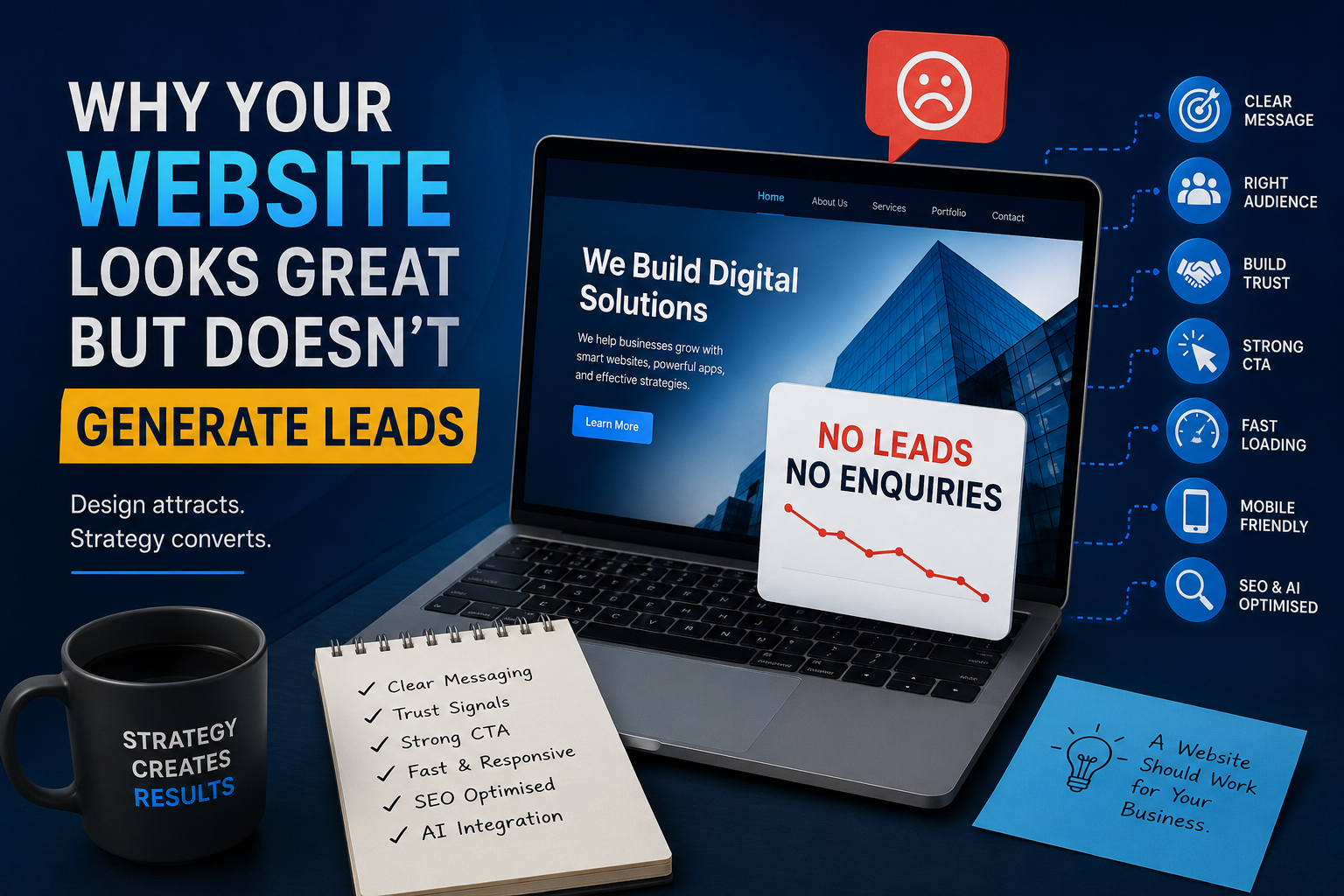
A modern website, with pictures, smooth movements, and a professional look, can make a great first impression. But if it is not getting people to ask about things, make sales, or get leads, then it is not doing what it is supposed to do.
Many businesses think that making their website look new again is enough to get customers. That is not true. A website is not something that shows what a company does. It is a tool that should help turn visitors into paying customers. If it is not doing that, something is not right.
In this blog, we will look at the common reasons why websites do not get leads and what you can do to make your website help your business grow.
1. Your Message Isn’t Clear
Visitors decide in a split second whether to stay on your website or leave. They want to know what you do, who you help, and why they should pick you. If they don’t get it, they’re gone.
Avoid vague headlines like:
- “Innovative Digital Solutions”
- “We Build the Future”
Instead, use clear messaging that explains your value.
For example:
Custom Software, Websites & Mobile Apps Built to Grow Your Business.
The clearer your message, the more likely visitors are to stay.
2. You’re Attracting the Wrong Audience
Getting a lot of people to visit your website does not mean much if they are not looking for what you have to offer.
Many companies just try to get more people to come to their site. They should really be trying to get people who are actually looking for what they do.
It is better to have a group of people who are searching for your services than a big group of people who are not going to buy anything. You should make your website and the things you write about help solve the problems that the people you want as customers are searching for.
3. Your Website Talks About You Instead of Your Customers
Many websites are filled with statements like:
- We are experts.
- We have years of experience.
- We build amazing websites.
Your visitors aren’t looking for your story first; they’re looking for solutions to their problems.
Instead of talking about your services, explain how your services help businesses save time, increase sales, improve efficiency, or reduce costs.
People buy results, not features.
4. Your Website Doesn’t Build Trust
Even if someone is interested in your services, they won’t contact you unless they trust your business.
Trust comes from showing proof.
Your website should include:
- Client testimonials
- Case studies
- Portfolio
- Business certifications
- Awards
- Team information
- Clear contact details
The more credibility you demonstrate, the easier it becomes for visitors to take the next step.
5. Your Call-to-Action Isn’t Strong Enough
One of the biggest reasons websites fail to generate leads is that they never ask visitors to take action.
Buttons like “Learn More” or “Read More” don’t encourage conversions.
Instead, use action-focused CTAs such as:
- Get a Free Consultation
- Request a Quote
- Start Your Project
- Hire Dedicated Developers
- Talk to Our Experts
Every important page should guide visitors toward a clear next step.
6. Your Website Loads Too Slowly
A slow website is really annoying for people who visit it. It also means you might lose customers.
There are reasons why a website can be slow.
- Large images can make it slower.
- Unnecessary animations can also slow it down.
- Poor hosting is another reason.
- Unoptimised code can slow down your website.
Websites that load quickly are better for users. They make people more engaged. Fast-loading websites often show up better in search results. A fast website can help you get customers. It is really important to have a fast website.
7. Your Website Isn’t Mobile-Friendly
Today, most users browse websites on their smartphones. If your website is difficult to navigate, slow to load, or poorly designed for mobile devices, visitors are likely to leave before contacting you.
A responsive website should provide the same smooth experience across desktops, tablets, and mobile devices.
8. You’re Ignoring User Experience (UX)
Good design is not about how something looks. It is also about how easy it’s to use.
If people have a time finding what they need on your website or if they get confused when they try to move from one page to another or if they have trouble filling out forms, they will probably leave your website.
Things like navigation and clear layouts and content that is easy to read and design that makes sense all help to make the experience better for the people who use your website, and that means you will get more people to do what you want them to do on your website.
9. Your Website Isn’t Optimised for Search Engines
A beautiful website is not enough to get leads if people cannot find it.
SEO helps your website show up when people search for your services.
Things like making your content better, improving how fast your pages load, doing SEO linking to other pages on your site, and understanding what people are searching for all help your website get more visible and attract the right kind of visitors.
In today’s search world, businesses need to think about more than traditional SEO. They should create content that works well with search engines that use intelligence. This way, businesses can stay ahead. Reach more people.
10. You’re Not Using AI to Improve Customer Experience
Modern customers expect fast responses and personalised experiences.
AI can help businesses improve customer engagement through:
- AI chatbots
- Intelligent search
- Personalised recommendations
- Automated lead qualification
- Workflow automation
When used correctly, AI enhances the customer experience and helps convert more visitors into leads.
How to Turn Your Website into a Lead-Generating Machine
If your website looks great but isn’t generating enquiries, it’s time to focus on performance, not just design.
A high-converting website should:
- Clearly communicate your services
- Target the right audience
- Build trust with testimonials and case studies
- Include strong calls-to-action
- Load quickly
- Be fully mobile-responsive
- Offer a seamless user experience
- Be optimised for SEO and AI search
- Use automation to improve customer engagement
When all these elements work together, your website becomes more than an online presence; it becomes a valuable business asset.
Final Thoughts
A beautiful website may attract attention, but only a strategic website generates leads.
If your business isn’t getting the enquiries or sales you expected, the problem may not be your marketing; it may be your website.
At Hub of Devs, we help businesses build high-performing websites that combine modern design with SEO, user experience, AI integration, and conversion-focused strategies. The result is a website that doesn’t just look professional; it helps your business grow.
Frequently Asked Questions
Why is my website getting traffic but no leads?
This often happens because of unclear messaging, weak calls-to-action, poor user experience, or attracting the wrong audience. Traffic alone doesn’t guarantee conversions.
How can I improve my website’s conversion rate?
Improve your messaging, simplify navigation, optimise for mobile, strengthen trust signals, and use clear CTAs that encourage visitors to take action.
Does website design affect lead generation?
Yes. Good design improves credibility and usability, but it should also support conversions through intuitive navigation, fast performance, and user-focused content.
Is SEO enough to generate leads?
No. SEO helps attract visitors, but your website also needs strong content, a great user experience, and effective conversion optimisation to turn visitors into customers.
How can AI improve my website?
AI can enhance customer support, automate lead qualification, personalise user experiences, and improve engagement through intelligent features like chatbots and smart recommendations.