
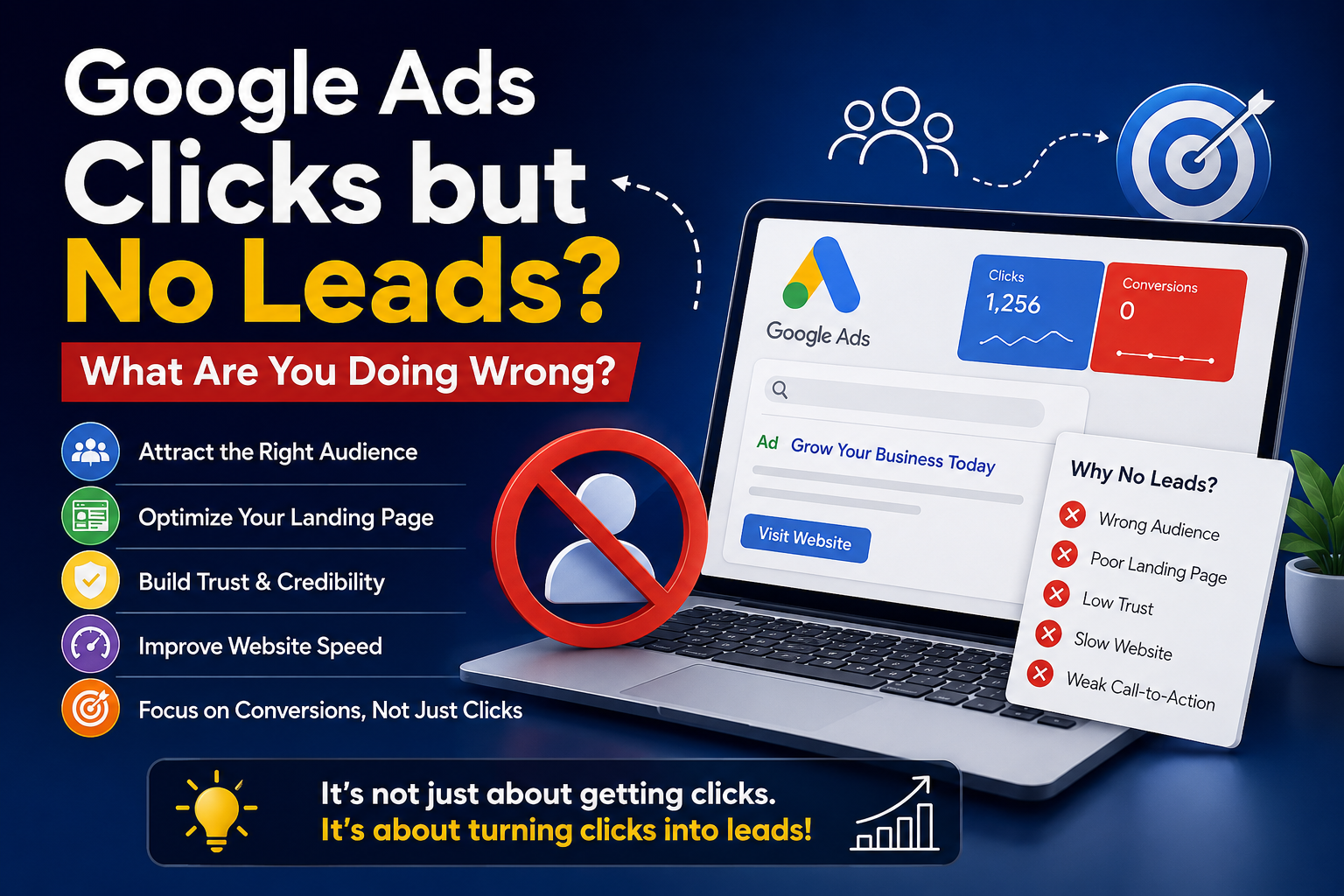
You’ve launched your Google Ads campaign, selected your keywords, written compelling ad copy, and set a healthy budget. After a few days, the results start coming in. Your impressions increase, clicks grow, and visitors land on your website.
Everything looks promising until you check your inbox.
- No enquiries.
- No phone calls.
- No quote requests.
- No new customers.
At first, it feels like Google Ads has failed. Many business owners immediately assume they need to increase their budget, change their keywords, or stop advertising altogether.
In reality, the problem often isn’t Google Ads.
The problem is what happens after someone clicks your ad.
Google Ads is designed to bring qualified visitors to your website. It can’t guarantee they’ll become customers. If your website, landing page, messaging, or overall user experience fails to build trust, visitors will leave just as quickly as they arrived.
If you’re getting clicks but no leads, your campaign isn’t necessarily broken. It’s revealing weaknesses elsewhere in your digital marketing strategy.
Let’s explore the most common reasons why this happens, and what you can do to fix it.
Your Ads Are Attracting the Wrong Audience
More clicks don’t always mean better results.
One of the most common mistakes businesses make is targeting broad keywords simply because they generate higher traffic.
For example, someone searching for “website design” may only be looking for inspiration, while another person searching for “web design agency for small businesses” is much closer to making a buying decision.
If your ads are attracting people who are only researching rather than purchasing, your click-through rate may look impressive while your lead generation remains disappointing.
- The goal isn’t to get more clicks.
- The goal is to attract the right clicks.
Review your keyword strategy regularly, use negative keywords to filter irrelevant searches, and focus on high-intent search terms that indicate a customer is ready to take action.
Your Landing Page Doesn’t Match the Ad
Imagine clicking an ad promising a free website consultation only to land on a generic homepage that says very little about the service you expected.
Most visitors won’t spend time searching for the information they came to find.
They’ll simply leave.
This disconnect between your advertisement and your landing page is one of the biggest reasons businesses lose potential customers.
- Your landing page should continue the conversation started by your ad.
- The headline should reflect the promise made in the advertisement.
- The content should answer the visitor’s questions.
- The call to action should make the next step obvious.
- Consistency builds confidence.
- Confusion creates exits.
Your Website Doesn’t Build Trust
People don’t become customers simply because they clicked an advertisement.
Before they contact your business, they want reassurance that they’re making the right decision.
Visitors naturally look for signs that your business is credible.
- Do you have customer reviews?
- Real testimonials?
- Case studies?
- A professional portfolio?
- Clear contact information?
- Industry certifications?
Without these trust signals, visitors may hesitate, even if they’re genuinely interested in your service.
Google Ads can bring people to your website.
Trust is what convinces them to stay.
Your Website Is Designed to Inform, Not Convert
Many business websites explain what they do but fail to guide visitors toward taking action.
After reading the page, visitors are left wondering:
- What should I do next?
- Should I call?
- Fill out a form?
- Book a consultation?
- Request a quote?
A high-converting landing page removes this uncertainty.
Every section should move visitors closer to one clear objective.
Too many options, unclear messaging, or weak calls-to-action often result in visitors leaving without engaging.
Your website shouldn’t simply provide information.
It should encourage action.
You’re Measuring Clicks Instead of Conversions
Many advertisers celebrate high click-through rates while overlooking the metric that actually matters.
Conversions.
A campaign generating 100 clicks and 20 qualified leads is far more valuable than a campaign producing 1,000 clicks and no enquiries.
Clicks show that people noticed your advertisement.
Conversions show that your marketing is working.
This is why proper conversion tracking is essential.
Without tracking form submissions, phone calls, bookings, or purchases, it’s almost impossible to understand what’s actually happening after visitors arrive.
Your Website Is Too Slow
First impressions happen quickly.
If your landing page takes several seconds to load, many visitors will leave before they even see your content.
Speed affects more than user experience.
It influences bounce rates, engagement, conversion rates, and even Google Ads performance.
A slow website can quietly waste hundreds or even thousands of dollars in advertising spend because visitors never stay long enough to become customers.
Improving website performance is often one of the fastest ways to improve conversion rates.
Your Message Isn’t Solving the Customer’s Problem
Businesses often spend too much time talking about themselves.
“We’ve been in business for 10 years.”
“We offer high-quality services.”
“We’re industry experts.”
While these statements may be true, they don’t answer the question every visitor is asking:
“How will you solve my problem?”
Customers care less about what you do and more about what they’ll achieve by working with you.
Instead of listing features, focus on outcomes.
Explain how your service saves time, increases revenue, reduces costs, or solves a specific challenge.
When visitors immediately understand the value you offer, they’re far more likely to become leads.
Your Competitors Aren’t Winning Because Their Ads Are Better
Many businesses assume competitors are succeeding because they have larger advertising budgets.
In reality, successful Google Ads campaigns are rarely built on advertising alone.
Strong landing pages, clear messaging, fast websites, trust signals, and a seamless user experience support them.
Google Ads simply opens the door.
Everything that happens afterward determines whether a visitor becomes a customer.
This is why two businesses can run similar campaigns and achieve completely different results.
One website convinces visitors to take action.
The other gives them reasons to leave.
How to Turn More Clicks into Leads
If your Google Ads campaign is generating traffic but not enquiries, don’t rush to increase your advertising budget.
Instead, evaluate the experience visitors have after clicking your ad.
Ask yourself:
- Does my landing page clearly match the promise made in my advertisement?
- Is my website fast and mobile-friendly?
- Does my business immediately appear trustworthy?
- Is there a clear and compelling call-to-action?
- Am I targeting people who are ready to buy or simply browsing?
- Am I tracking actual conversions rather than just clicks?
Small improvements in these areas often produce better results than spending more on advertising.
Google Ads performs best when every part of the customer journey works together.
Final Thoughts
Google Ads isn’t just about attracting visitors.
It’s about attracting the right visitors and giving them a compelling reason to become customers.
If your campaign is generating clicks but no leads, don’t assume your ads are failing.
More often than not, they’re exposing opportunities to improve your website, messaging, user experience, or conversion strategy.
Businesses that achieve the best results don’t simply focus on getting more traffic.
They focus on making every click count.
Because in digital marketing, a click is only the beginning.
The real success comes from what happens next.
Frequently Asked Questions
Why am I getting Google Ads clicks but no leads?
This usually happens because of issues after the click, such as weak landing pages, poor user experience, unclear messaging, slow website performance, or targeting the wrong audience.
Can a bad landing page affect Google Ads performance?
Yes. Even a well-optimized ad campaign can struggle if visitors land on a page that doesn’t match their expectations or encourage them to take action.
Should I increase my Google Ads budget if I’m not getting leads?
Not immediately. First, review your targeting, landing page, conversion tracking, website speed, and calls-to-action. Improving these areas often delivers better results than increasing ad spend.
How important is conversion tracking in Google Ads?
Conversion tracking is essential because it shows which campaigns, keywords, and ads generate actual enquiries or sales, not just clicks.
How can I improve my Google Ads conversion rate?
Focus on targeting high-intent keywords, creating dedicated landing pages, improving website speed, strengthening trust signals, and making your calls-to-action clear and compelling.