
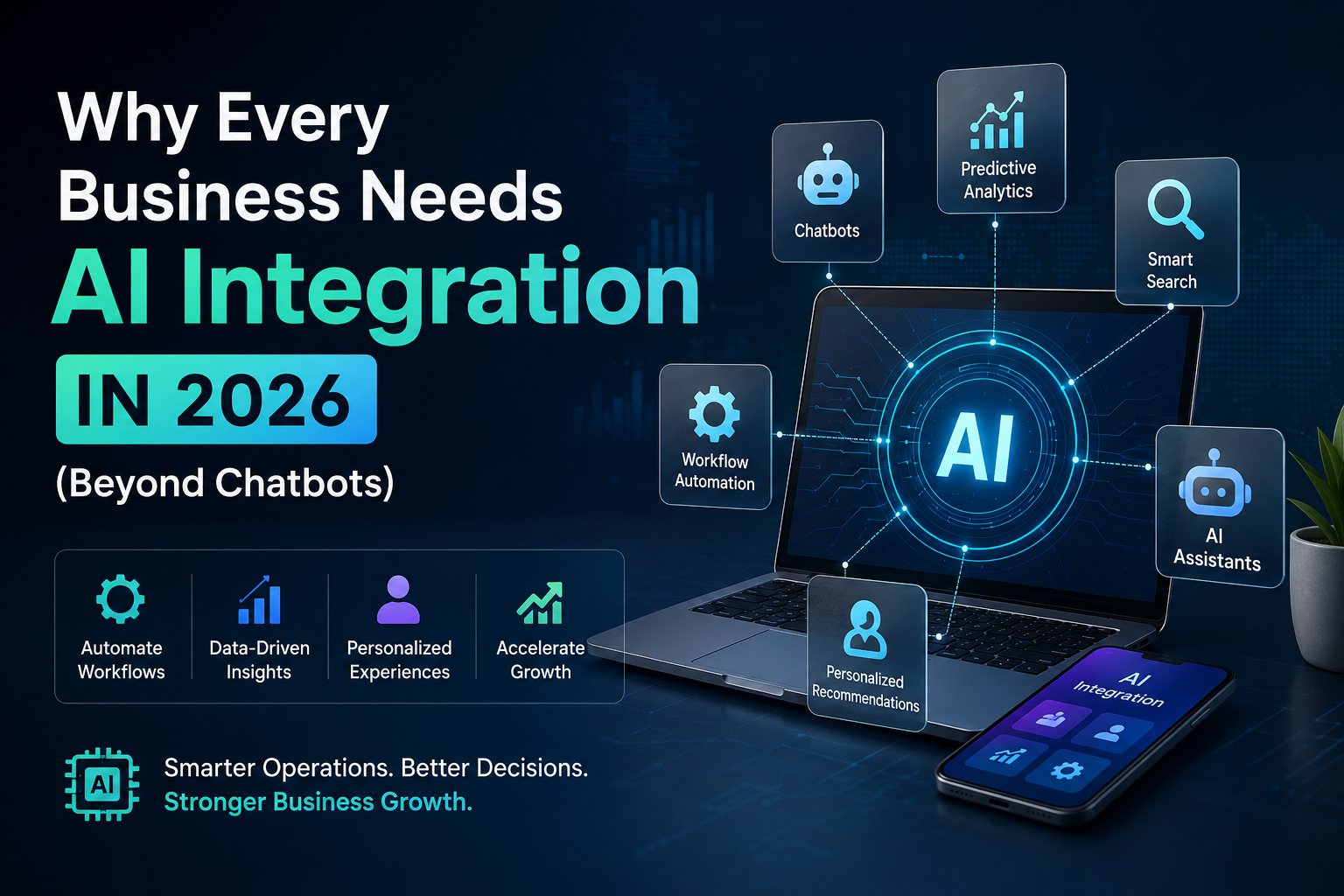
Artificial intelligence has become one of the biggest drivers of business innovation, yet many companies still associate AI with a single feature: a chatbot on their website. While conversational AI has transformed customer support, it represents only a small part of what artificial intelligence can do for modern businesses.
In 2026, AI will no longer be a luxury or an experimental technology. It has become an essential business tool that helps organisations automate repetitive tasks, analyse data, personalise customer experiences, improve decision-making, and accelerate growth. Businesses that embrace AI strategically are gaining a competitive advantage, while those that delay adoption risk falling behind.
If you think AI starts and ends with chatbots, it’s time to look at the bigger picture.
AI Integration Is Transforming Every Industry
AI is quietly changing how businesses operate behind the scenes. Instead of replacing people, it enhances productivity, reduces manual work, and enables teams to focus on higher-value tasks.
Whether you’re running an ecommerce store, a healthcare organisation, a financial institution, or a growing startup, AI can improve efficiency across nearly every department.
Modern businesses are using AI to:
- Automate repetitive workflows
- Deliver personalised customer experiences
- Analyse large volumes of data in seconds
- Predict customer behaviour
- Improve operational efficiency
- Strengthen cybersecurity
- Generate business insights
- Optimise marketing campaigns
- Improve sales forecasting
The companies growing fastest today are not simply using AI; they’re integrating it into their everyday operations.
AI Is More Than Just Chatbots
Chatbots are often the first AI feature businesses adopt because they’re visible and easy to understand. However, the real value of AI lies in what happens behind the scenes.
AI integration can transform your software, website, or mobile application by introducing intelligent capabilities that make your business faster, smarter, and more efficient.
Some examples include:
Intelligent Recommendations
AI analyses customer behaviour to recommend products, services, or content that matches individual preferences, increasing engagement and conversions.
Workflow Automation
Manual processes such as approvals, scheduling, document processing, and repetitive administrative tasks can be automated, saving valuable time and reducing human error.
Predictive Analytics
AI identifies trends before they become obvious, helping businesses forecast demand, understand customer behaviour, and make more informed decisions.
Smart Search
Instead of relying on basic keyword searches, AI-powered search understands user intent and delivers more accurate, relevant results.
AI Assistants
Internal AI assistants help employees retrieve information, answer questions, generate reports, and complete tasks more efficiently.
Why Businesses Are Investing in AI Integration
The biggest benefit of AI isn’t automation; it’s scalability.
As businesses grow, manual processes become slower, more expensive, and harder to manage. AI enables organisations to scale operations without proportionally increasing costs.
Businesses investing in AI integration are seeing improvements in:
- Customer satisfaction
- Employee productivity
- Operational efficiency
- Marketing performance
- Sales conversion rates
- Decision-making speed
- Cost reduction
- Business scalability
Rather than replacing teams, AI empowers them to work more efficiently and focus on strategic initiatives.
AI Integration Across Different Industries
Every industry is discovering unique ways to leverage artificial intelligence.
Ecommerce
AI recommends products, predicts buying behaviour, manages inventory, and personalises shopping experiences.
Healthcare
AI assists with appointment scheduling, patient engagement, medical data analysis, and remote monitoring.
Finance
Banks and financial institutions use AI to detect fraud, automate compliance, assess risk, and improve customer support.
Logistics
AI optimises delivery routes, forecasts demand, and improves supply chain management.
Real Estate
AI matches buyers with suitable properties, predicts market trends, and automates lead qualification.
Education
Learning platforms personalise educational content based on each student’s progress and learning style.
Common Mistakes Businesses Make with AI
Many organisations adopt AI without a clear strategy.
Some common mistakes include:
- Implementing AI because it’s trending rather than solving a real business problem.
- Using disconnected AI tools that don’t integrate with existing systems.
- Ignoring data quality, which reduces AI accuracy.
- Expecting AI to replace human expertise instead of supporting it.
- Choosing generic AI solutions instead of custom integrations.
Successful AI implementation starts with understanding your business objectives, not selecting the latest technology.
The Future Belongs to AI-Driven Businesses
Artificial intelligence is becoming a standard feature in modern websites, software platforms, and mobile applications.
Customers increasingly expect intelligent search, personalised recommendations, instant support, automated experiences, and seamless interactions. Businesses that fail to meet these expectations may find it harder to compete as AI becomes the norm.
The question is no longer whether your business should adopt AI. The real question is how quickly you can integrate it into the systems that matter most.
How Hub of Devs Helps Businesses Integrate AI
At Hub of Devs, we believe AI should solve real business challenges, not simply add another feature to your software.
Our team develops AI-enabled websites, mobile applications, and custom software with capabilities such as intelligent automation, conversational AI, predictive analytics, recommendation engines, AI-powered search, and workflow optimisation. Every solution is designed around your business goals, helping you improve efficiency, enhance customer experiences, and create long-term value.
Whether you’re building a new digital product or enhancing an existing one, we help you integrate AI in ways that deliver measurable business impact.
Final Thoughts
AI is no longer just about chatbots or automation; it’s becoming the foundation of how modern businesses operate. From smarter decision-making and personalised customer experiences to streamlined workflows and scalable operations, AI integration is reshaping the way organisations grow and compete.
Businesses that embrace AI today will be better positioned to adapt, innovate, and lead tomorrow. The key isn’t adopting AI for the sake of it; it’s integrating the right AI capabilities into the right parts of your business to create meaningful, lasting results.
Frequently Asked Questions
1. What is AI integration in business?
AI integration is the process of adding artificial intelligence capabilities into your existing business systems, websites, mobile apps, or software. It helps automate tasks, improve decision-making, enhance customer experiences, and increase operational efficiency.
2. Is AI integration only about chatbots?
No. While AI chatbots are popular, AI integration also includes workflow automation, predictive analytics, intelligent search, recommendation engines, image recognition, voice assistants, fraud detection, and data analysis. Modern businesses use AI across multiple operations, not just customer support.
3. How can AI integration benefit my business?
AI integration can improve productivity, automate repetitive tasks, personalise customer experiences, reduce operational costs, enhance decision-making, and help businesses scale more efficiently.
4. Which industries can benefit from AI integration?
Almost every industry can benefit from AI, including healthcare, ecommerce, finance, education, logistics, manufacturing, real estate, and professional services. AI solutions can be customised to meet the unique needs of different industries.
5. Can AI be integrated into existing websites and mobile apps?
Yes. AI features such as chatbots, intelligent search, personalised recommendations, workflow automation, and predictive analytics can be integrated into existing websites, mobile applications, and business software without rebuilding the entire platform.