
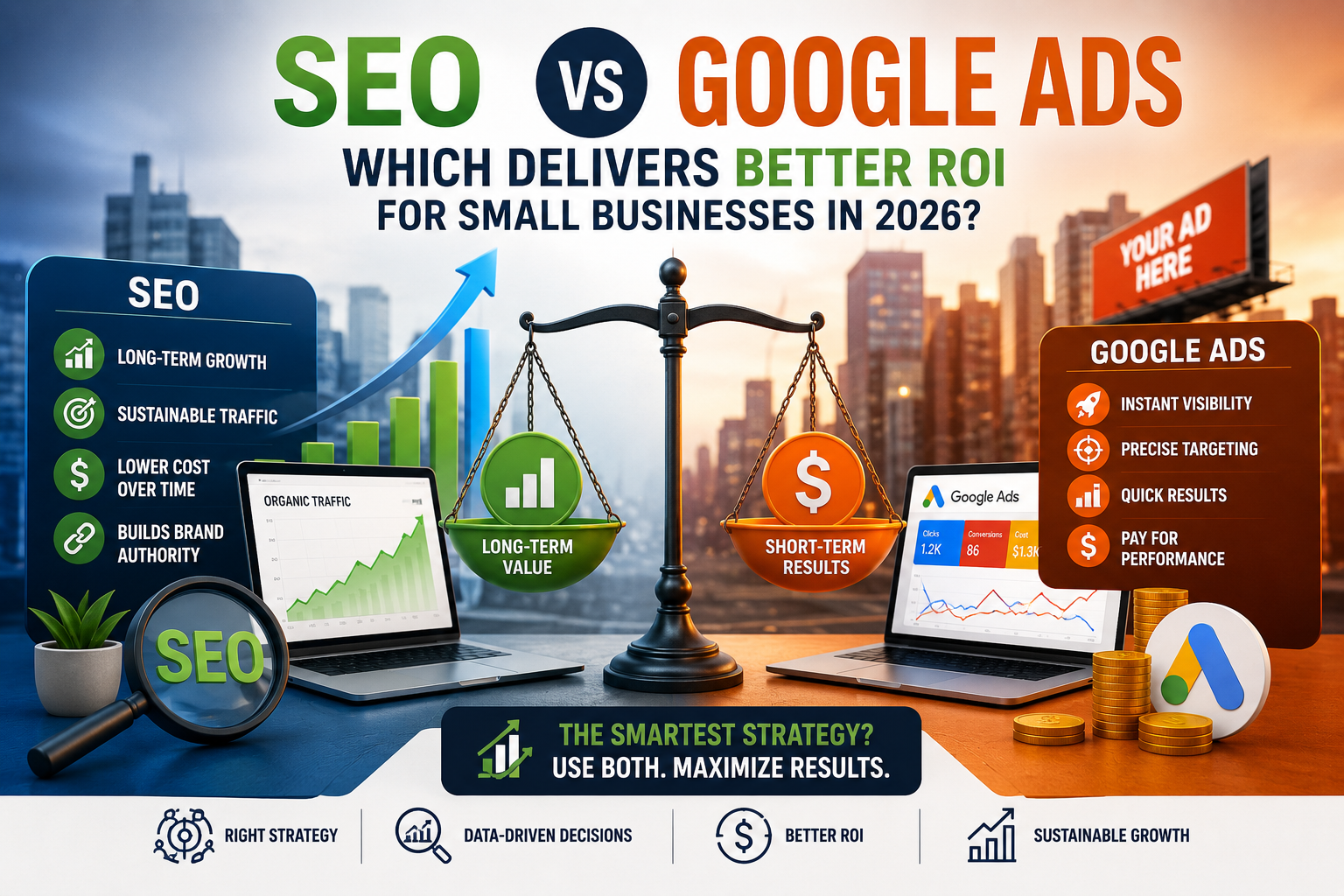
For small businesses, every marketing dollar matters. Unlike large corporations with substantial advertising budgets, small businesses often need to make careful decisions about where to invest their resources. One of the most common questions business owners ask is whether they should focus on SEO or Google Ads.
For years, marketers have debated which channel delivers better results. Some argue that SEO provides sustainable long-term growth, while others believe Google Ads is the fastest way to generate leads and sales. The reality is that both channels can be highly effective, but they work in very different ways.
In 2026, this decision has become even more complex. Search behavior is changing, AI-powered search experiences are influencing how people discover businesses, and competition continues to increase across nearly every industry. As a result, understanding the return on investment (ROI) of both SEO and Google Ads is more important than ever.
The question is not simply which channel is better. The real question is which channel delivers the best ROI for your business goals, budget, and growth stage.
Understanding ROI in Digital Marketing
Before comparing SEO and Google Ads, it is important to understand what ROI actually means.
Return on investment is not just about generating traffic. A marketing channel may bring thousands of visitors to a website, but if those visitors do not become customers, the investment may not be worthwhile.
True ROI considers several factors, including lead generation, customer acquisition costs, conversion rates, customer lifetime value, and long-term business growth.
For example, a company that spends $1,000 on advertising and generates $5,000 in revenue has achieved a positive return. However, if another company spends the same amount and builds a long-term source of traffic that continues producing leads for years, the value of that investment may be significantly greater over time.
This distinction is critical when comparing SEO and Google Ads because each channel creates value differently.
What Makes Google Ads Attractive for Small Businesses?
Google Ads is often the first marketing channel businesses consider because it can produce results quickly.
Once a campaign is launched, ads can begin appearing in search results almost immediately. Businesses can target specific keywords, locations, demographics, and customer segments with a high degree of precision.
This speed is one of Google Ads’ biggest advantages.
A local plumbing company, for example, can launch a campaign targeting emergency plumbing services and begin receiving inquiries the same day. For businesses that need immediate visibility, this can be extremely valuable.
Google Ads also provides predictable scalability. If campaigns are performing well, businesses can increase their budget and potentially generate more leads without waiting months for rankings to improve.
For startups, newly launched websites, and businesses entering competitive markets, this ability to generate immediate traffic is often difficult to ignore.
The Limitations of Google Ads
Despite its advantages, Google Ads is not without challenges.
The most obvious issue is cost.
In many industries, cost-per-click continues to rise as competition increases. Legal services, insurance, home improvement, software, and financial services often have some of the highest advertising costs online.
For small businesses with limited budgets, these rising costs can quickly reduce profitability.
Another challenge is sustainability.
The moment advertising stops, traffic typically stops as well. Unlike SEO, which can continue generating visitors after the initial investment, paid advertising requires ongoing spending to maintain visibility.
Many businesses find themselves trapped in a cycle where they must continue increasing their ad budget simply to maintain the same level of traffic and leads.
This does not mean Google Ads is ineffective. It simply means businesses should understand that they are essentially renting visibility rather than building a long-term asset.
Why SEO Remains a Powerful Long-Term Investment
SEO operates differently from paid advertising.
Instead of paying for every visitor, businesses invest in improving their visibility within organic search results. This involves creating valuable content, optimizing website performance, improving user experience, and building topical authority over time.
The biggest advantage of SEO is sustainability.
A well-optimized website can continue attracting visitors long after content is published. Unlike Google Ads, where visibility disappears when spending stops, SEO creates assets that can generate traffic and leads for months or even years.
This long-term value is one of the primary reasons businesses continue investing heavily in search engine optimization.
When SEO is executed effectively, the cost of acquiring each visitor often decreases over time. As rankings improve and organic traffic grows, businesses become less dependent on paid advertising to generate leads.
For small businesses seeking sustainable growth, this can be a significant competitive advantage.
The Reality of SEO in 2026
While SEO remains valuable, it is not as straightforward as it once was.
Search results today are far more competitive than they were five or ten years ago. Businesses must compete not only with competitors but also with AI Overviews, featured snippets, video results, local packs, and other search features that occupy valuable screen space.
Ranking for competitive keywords often requires significant effort, patience, and expertise.
Results may take several months to appear, particularly for newer websites.
This delayed gratification is one reason some small businesses struggle with SEO. Business owners often need leads immediately, making it difficult to wait for long-term results.
However, businesses that remain committed to SEO frequently benefit from lower customer acquisition costs and greater stability over time.
The challenge is balancing short-term needs with long-term growth objectives.
Comparing ROI: SEO vs Google Ads
When comparing ROI, there is no universal winner because outcomes depend heavily on business goals.
Google Ads often delivers stronger short-term ROI because businesses can generate traffic and leads almost immediately. For companies launching a new service, promoting seasonal offers, or entering a competitive market, this speed can provide significant value.
SEO, on the other hand, typically delivers stronger long-term ROI. Once rankings are established, businesses can continue receiving traffic without paying for every click.
A useful way to think about the difference is this:
Google Ads buys visibility.
SEO builds visibility.
One provides immediate access to potential customers.
The other creates a lasting foundation for future growth.
Businesses that focus exclusively on either channel may miss opportunities available through the other.
Which Channel Converts Better?
Conversion rates depend largely on search intent.
Google Ads often captures users who are actively searching for a solution and ready to take action. Keywords with strong commercial intent can generate highly qualified leads.
However, organic search traffic often carries a different type of value.
Users frequently perceive organic results as more trustworthy than advertisements. Many consumers deliberately skip paid ads and choose organic listings because they believe those results are more credible.
This trust factor can lead to stronger engagement and improved conversion rates in certain industries.
Ultimately, conversion performance depends on factors such as website quality, user experience, offer strength, and audience targeting rather than the traffic source alone.
The Smartest Approach for Small Businesses
For most small businesses, the answer is not SEO or Google Ads.
It is SEO and Google Ads.
The most successful businesses use Google Ads to generate immediate traffic while simultaneously investing in SEO to build long-term visibility.
This approach provides both short-term and long-term benefits.
Paid advertising helps businesses acquire customers immediately, while SEO gradually reduces reliance on advertising by creating a sustainable source of organic traffic.
Over time, businesses can shift more resources toward the channels producing the strongest returns.
Instead of viewing SEO and Google Ads as competing strategies, businesses should consider how the two can complement each other.
How AI Search Is Changing the Conversation
The rise of AI-powered search experiences is adding a new layer to this discussion.
Google’s AI Overviews are changing how users interact with search results. Some informational searches now receive direct answers without requiring users to visit a website.
As a result, businesses can no longer rely solely on traditional ranking strategies.
Brand recognition, authority, and trust are becoming increasingly important.
Whether traffic comes through SEO or Google Ads, businesses that build strong brands are likely to perform better in the long run.
This shift reinforces the importance of creating valuable content, improving user experience, and building credibility rather than focusing exclusively on rankings or ad campaigns.
Final Thoughts
The debate between SEO and Google Ads has existed for years, but the answer has never been as simple as choosing one over the other.
Google Ads remains one of the fastest ways for small businesses to generate visibility, leads, and sales. It provides immediate results and allows businesses to target specific audiences with precision.
SEO, however, continues to offer unmatched long-term value. It helps businesses build authority, reduce customer acquisition costs, and create sustainable growth that endures even when advertising budgets are paused.
For small businesses in 2026, the best ROI often comes from understanding how both channels contribute to broader business objectives.
If immediate growth is the priority, Google Ads may provide the fastest path forward.
If long-term stability and sustainable visibility are the goal, SEO remains one of the most valuable investments a business can make.
The strongest strategy is rarely choosing one over the other. It is understanding when to use each channel and how they can work together to support business growth.
Frequently Asked Questions
Is SEO better than Google Ads for small businesses?
SEO is often better for long-term growth because it can continue generating traffic without ongoing advertising costs. However, Google Ads can deliver faster results, making it valuable for businesses that need immediate leads.
How long does SEO take to show results?
SEO typically takes several months to produce meaningful results. The timeline depends on competition, website authority, content quality, and the effectiveness of the overall strategy.
Are Google Ads worth it for small businesses?
Yes, Google Ads can be highly effective when campaigns are properly managed. They are particularly useful for generating immediate visibility and targeting high-intent customers.
Which has a better ROI in the long run?
For many businesses, SEO provides stronger long-term ROI because traffic can continue after the initial investment. Google Ads generally deliver stronger short-term ROI due to their immediate impact.
Should small businesses invest in both SEO and Google Ads?
In many cases, yes. Combining both channels allows businesses to generate immediate traffic through paid advertising while building sustainable organic visibility through SEO.