

Artificial intelligence has changed the way software is built.
Today, a founder with no coding experience can describe an idea to an AI tool and receive a working application within minutes. Tools like ChatGPT, Claude, Cursor, Bolt, Lovable, and Replit AI have made it possible to build websites, dashboards, SaaS products, and internal business tools faster than ever before.
This new approach has become known as vibe coding.
Instead of writing every line of code manually, users simply explain what they want, and AI generates the solution.
For startups and businesses, it sounds almost too good to be true.
Build faster.
Spend less.
Launch sooner.
So why are experienced developers raising concerns?
The answer isn’t that vibe coding doesn’t work.
The answer is that building software and maintaining software are two very different things.
While vibe coding can accelerate development, it can also introduce hidden problems that many businesses don’t discover until much later.
What Is Vibe Coding?
Vibe coding is the process of building software primarily through AI prompts rather than traditional coding.
A user might type:
Build me a customer portal with user authentication, payment integration, and an admin dashboard.
The AI generates the code.
The user tests it.
The application works.
Within hours, something that once required weeks of development can be running.
This has made vibe coding incredibly attractive to:
- Startup founders
- Small businesses
- Product managers
- Marketing teams
- Entrepreneurs with limited technical experience
For prototyping and experimentation, it’s an incredibly powerful approach.
However, the excitement surrounding vibe coding often overlooks the challenges that come after launch.
The First Hidden Problem: Nobody Understands the Code
One of the biggest risks of vibe coding is surprisingly simple.
Many people can generate code.
Far fewer people understand it.
A business owner may successfully build an application using AI prompts without ever reviewing the underlying architecture.
- Everything seems fine until something breaks.
- A payment system fails.
- A database query becomes slow.
- An integration stops working.
At that point, the question becomes:
Who understands the code well enough to fix it?
Software isn’t valuable because it launches successfully.
It’s valuable because it continues working reliably over time.
If nobody understands how the system was built, even small issues can become expensive problems.
AI Can Create Technical Debt Faster Than Humans
Technical debt is one of the most overlooked challenges in software development.
It refers to shortcuts, poor architectural decisions, and code quality issues that make future development more difficult.
Traditionally, technical debt accumulates gradually
AI-generated code can accumulate much faster.
Why?
Because AI prioritizes solving the immediate problem.
It doesn’t naturally think about:
- Future scalability
- Long-term maintenance
- Business growth
- Architectural consistency
As a result, developers often discover:
- Repeated code blocks
- Inconsistent logic
- Multiple solutions solving the same problem
- Poor file organization
The application may function perfectly today while quietly becoming harder to maintain tomorrow.
Security Is Often an Afterthought
Most businesses focus on features.
Customers focus on usability.
Developers focus on security.
Unfortunately, AI doesn’t always prioritize security unless specifically instructed to do so.
A simple prompt such as:
Build a login system.
may generate something functional.
But does it include:
- Proper authentication?
- Secure password storage?
- Input validation?
- Rate limiting?
- Protection against common attacks?
Not necessarily.
AI can generate secure solutions when guided correctly.
The challenge is that many users don’t know what security requirements to ask for in the first place.
This creates hidden vulnerabilities that may not become visible until the system is under real-world pressure.
The Prompting Problem Nobody Talks About
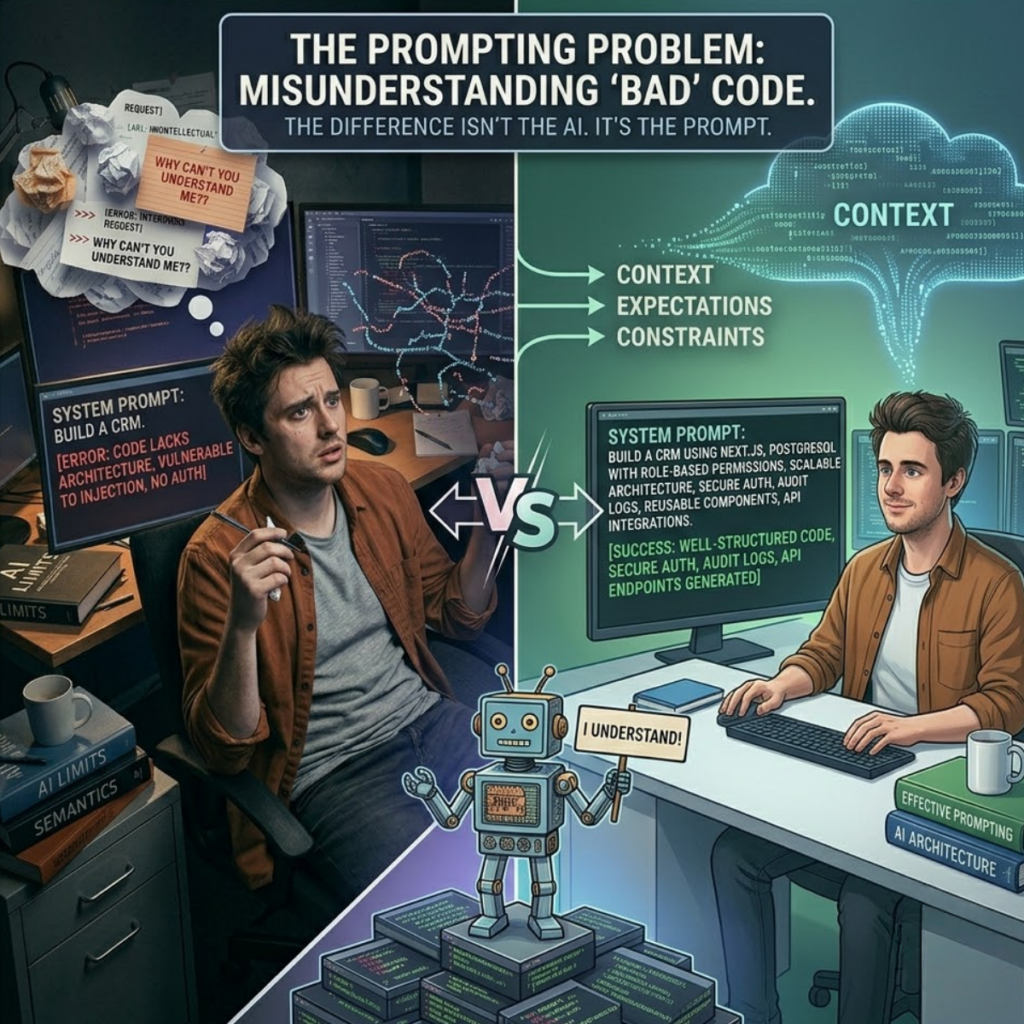
One of the biggest misconceptions surrounding AI development is that AI simply generates bad code.
In reality, the quality of AI-generated code often reflects the quality of the instructions it receives.
Consider this prompt:
Build a CRM.
Now compare it to:
Build a CRM using Next.js and PostgreSQL with role-based permissions, scalable architecture, secure authentication, audit logs, reusable components, and API integrations.
The second prompt provides context.
- It defines expectations.
- It creates constraints.
- The resulting code is often dramatically better.
This is why experienced developers frequently get better results from AI tools. They understand what information needs to be provided. The difference isn’t the AI. It’s the prompt.
Scaling Is Where Many AI-Built Projects Struggle
A common mistake among businesses is assuming that a working application is automatically scalable.
An AI-generated solution might perform perfectly with:
- 10 users
- 50 users
- 100 users
But what happens when:
- Thousands of users join?
- Large databases grow?
- Are new features introduced?
- Are multiple integrations added?
Scaling software requires more than generating code.
It requires thoughtful planning around:
- Infrastructure
- Database design
- Performance optimization
- System architecture
These are areas where human expertise still plays a critical role.
Why Experienced Developers Get Better Results From AI
A beginner and a senior developer can use the same AI tool and receive completely different outcomes.
Why?
Because experienced developers understand:
- Architecture
- Security
- Scalability
- Performance
- Testing
- Maintainability
When AI generates code, they know:
- What to keep
- What to improve
- What to reject
This is why many developers don’t see AI as a replacement.
They see it as an accelerator.
AI helps them move faster, but their expertise still guides the process.
The Difference Between Building Software and Building a Business
One aspect often overlooked in AI discussions is that businesses don’t need code.
Businesses need outcomes.
A website isn’t valuable because it contains thousands of lines of code.
It’s valuable because it:
- Generates leads
- Supports customers
- Processes transactions
- Improves operations
Successful software development involves understanding business goals, user behavior, workflows, and long-term growth strategies.
AI can generate code.
Understanding business strategy still requires human judgment.
Is Vibe Coding Replacing Developers?
This question appears frequently in technology discussions.
The short answer is no.
Vibe coding is changing how software is built, but it isn’t eliminating the need for developers.
Instead, it’s changing their role.
Developers are spending less time on repetitive coding tasks and more time focusing on:
- Architecture
- Problem-solving
- Security
- System design
- Business requirements
The future isn’t AI versus developers.
It’s developers who understand AI who outperform those who don’t.
Final Thoughts
Vibe coding represents one of the most exciting shifts in modern software development.
It lowers barriers, accelerates innovation, and allows businesses to bring ideas to life faster than ever before.
But speed alone doesn’t guarantee success.
The biggest misconception about vibe coding is that generating software and building reliable software are the same thing.
They aren’t.
Many of the problems businesses experience with AI-generated applications don’t happen because AI is flawed.
They happen because expectations are unrealistic.
Poor prompts produce poor outcomes.
Lack of planning creates technical debt.
Ignoring architecture creates scalability problems.
Skipping security reviews creates risk.
AI is not the problem.
The way people use AI is often the problem.
The businesses that will benefit most from vibe coding are not the ones replacing expertise with AI.
They are the ones combining AI with expertise.
Because in modern software development, the competitive advantage is no longer access to AI.
The competitive advantage is knowing how to use it effectively.
Frequently Asked Questions
What is vibe coding?
Vibe coding is the practice of building software primarily through AI prompts rather than manually writing every line of code.
Is vibe coding good for startups?
Yes. Vibe coding can be useful for prototyping ideas, validating concepts, and building MVPs quickly. However, growing products often require proper architecture and development expertise.
What are the biggest risks of vibe coding?
Common risks include technical debt, poor scalability, security vulnerabilities, inconsistent code quality, and long-term maintenance challenges.
Can AI-generated applications scale successfully?
They can, but scalability depends heavily on architecture, infrastructure planning, and code quality rather than the AI tool itself.
Will vibe coding replace software developers?
No. AI is changing how developers work, but expertise in architecture, security, business requirements, and system design remains essential.
Why do experienced developers get better results from AI?
Experienced developers understand how to create effective prompts, review generated code, identify risks, and ensure software is scalable and maintainable.