
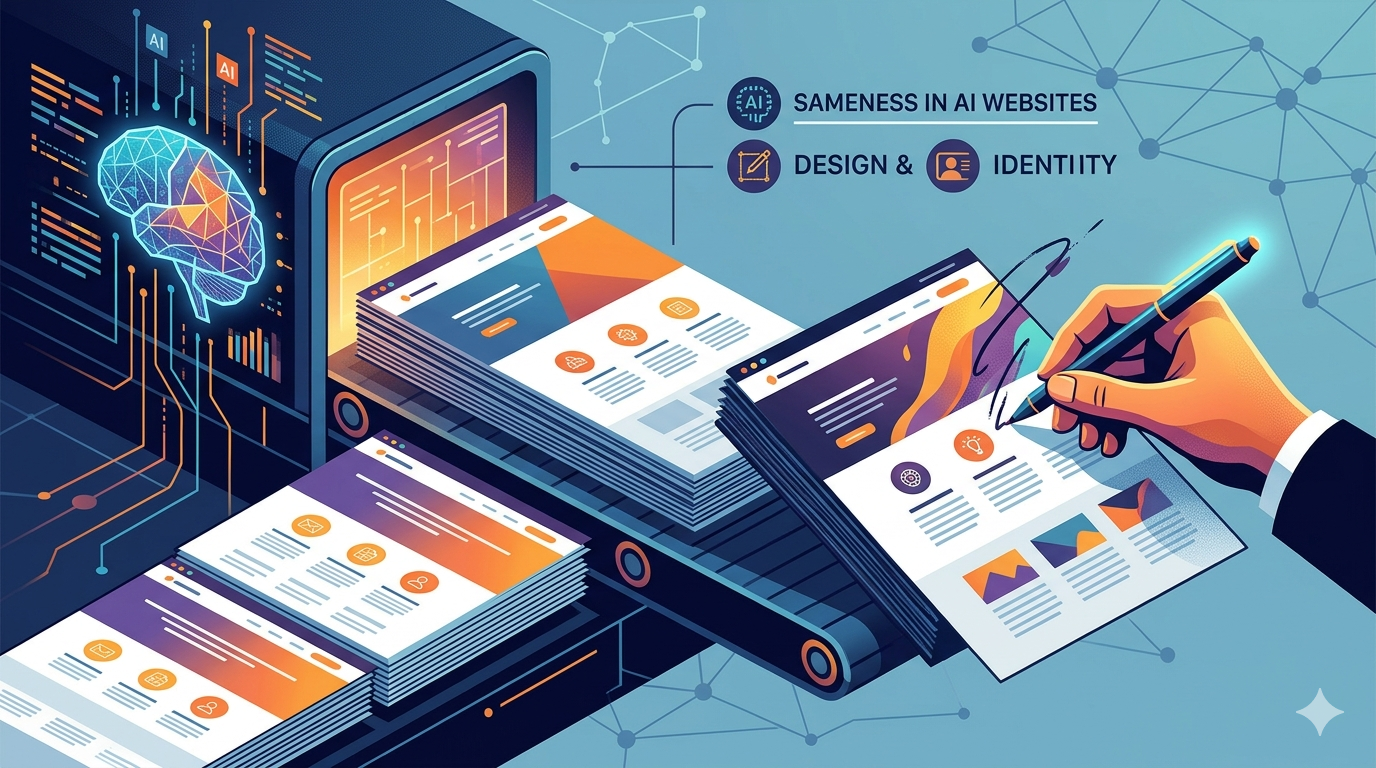
Artificial intelligence has transformed website development. Tasks that once required weeks of planning, design, content creation, and development can now be completed in a matter of hours. Modern AI-powered website builders can generate layouts, write copy, suggest images, and even create functional websites from a simple prompt.
For startups, small businesses, and entrepreneurs, this technology has made website creation more accessible than ever before. Businesses no longer need large budgets or technical expertise to establish an online presence. Instead, they can use AI tools to launch websites quickly and at a fraction of the traditional cost.
However, as AI-generated websites become increasingly common, a new challenge is beginning to emerge. Many websites built with AI tools look surprisingly similar. The layouts often follow the same structure, the messaging sounds familiar, and the overall user experience feels repetitive. While these websites may be functional and visually appealing, they often struggle to create a unique identity.
This raises an important question: if AI is designed to help businesses innovate and work more efficiently, why are so many AI-generated websites starting to look alike?
The answer lies in the way artificial intelligence learns, the data it relies on, and the way businesses are currently using these tools. Understanding these factors can help companies use AI more effectively while avoiding the trap of creating a website that blends into the crowd.
The Rise of AI Website Builders
Over the last few years, AI website builders have become one of the fastest-growing segments of the web development industry. Platforms such as Wix AI, Framer AI, Durable, and other AI-powered solutions have made it possible to generate a complete website by answering a few questions or providing a short prompt.
The appeal of these tools is easy to understand. Traditional website development often involves multiple stages, including planning, design, content creation, development, testing, and optimization. AI significantly reduces the time required for many of these tasks, allowing businesses to launch websites faster than ever before.
For startups and small businesses operating with limited resources, this efficiency can be extremely valuable. AI tools can help reduce costs, speed up development timelines, and remove many of the technical barriers that previously prevented businesses from building professional websites.
However, AI website builders are primarily designed to produce websites that are functional and effective. Their goal is not necessarily to create something unique. Because these tools rely on proven design patterns and established user experience principles, many of the websites they generate end up sharing similar structures and visual elements.
While this approach often results in clean and user-friendly websites, it can also make it difficult for businesses to stand out from competitors who are using the same technology.
Why AI-Generated Websites Often Follow the Same Design Patterns
One of the primary reasons AI-generated websites look similar is that artificial intelligence relies heavily on pattern recognition.
When an AI system generates a website, it does not create a design from scratch in the way a human designer might. Instead, it analyzes large amounts of existing data and identifies patterns that have proven successful across thousands of websites.
As a result, many AI-generated websites follow a familiar structure. They often begin with a large hero section, followed by a brief introduction, service highlights, customer testimonials, and a call-to-action. These design elements are commonly used because they help users navigate information quickly and encourage conversions.
From a usability perspective, there is nothing wrong with this approach. In fact, many successful websites use a similar structure because it works. The challenge arises when thousands of businesses rely on the same AI-generated framework.
When users repeatedly encounter websites with nearly identical layouts and content structures, it becomes increasingly difficult for brands to create a memorable impression. Even if the products or services are different, the overall experience can feel predictable, reducing the impact of the brand itself.
The Training Data Problem
Another major reason AI-generated websites often look alike is the data used to train artificial intelligence models.
AI systems learn by analyzing existing examples. In the case of website builders, this means studying thousands of websites, landing pages, and design systems. The AI then identifies common patterns and uses those patterns to generate new designs.
This process creates a natural tendency toward repetition.
If a particular layout appears frequently within the training data, the AI is more likely to reproduce that layout. If certain color schemes, content structures, or design trends are commonly associated with successful websites, the AI will often recommend similar approaches.
Over time, this creates a feedback loop. Businesses use AI to generate websites, those websites become part of the online ecosystem, and future AI systems learn from those examples. As the cycle continues, the same design conventions become increasingly dominant.
This does not mean AI lacks creativity. Rather, it means AI is optimized to identify what is most common and most likely to work. True innovation often requires challenging existing conventions, which remains an area where human creativity plays a critical role.
Why Generic Websites Can Hurt Brand Identity
A website is often one of the first interactions a customer has with a business. Within seconds of arriving on a website, visitors begin forming opinions about the brand, its professionalism, and its credibility.
Because first impressions matter, differentiation is essential.
When a website closely resembles dozens of competitors, it becomes more difficult to establish a strong brand identity. Visitors may remember the general experience but struggle to remember which company provided it.
This can affect several important business outcomes, including brand recognition, customer trust, user engagement, and conversion rates.
A generic website is not necessarily a bad website. It may load quickly, look professional, and provide a positive user experience. However, if it fails to communicate what makes a business unique, it may struggle to create a lasting impression.
In competitive industries, this can become a significant disadvantage. Businesses need more than functionality; they need a digital presence that reflects their values, personality, and unique selling proposition.
What Developers and Designers Are Saying
The conversation around AI-generated websites has become increasingly common within web development and design communities.
Most developers and designers agree that AI is an incredibly useful tool. It can accelerate workflows, automate repetitive tasks, generate code, and help teams move from concept to execution much faster than before.
However, many professionals have also observed that AI tends to produce safe solutions rather than bold or innovative ones.
Safe designs are generally effective because they follow established best practices. The downside is that they rarely create memorable experiences. A website that follows every standard convention may function well, but it may not inspire users or create a strong emotional connection with the brand.
Many designers argue that the most successful websites are built around a deep understanding of the target audience, customer behavior, and business goals. These elements require strategic thinking, research, and creativity—areas where human expertise remains essential.
This is why many agencies are not replacing designers with AI. Instead, they are using AI to improve efficiency while relying on human creativity to guide the overall vision and strategy.
Can AI Create Truly Unique Websites?
The idea that AI can only create generic websites is not entirely accurate.
AI is capable of contributing to highly unique projects, but the quality of the outcome depends heavily on how the technology is used. Businesses that rely solely on default prompts and automated recommendations often end up with websites that feel similar to countless others.
On the other hand, businesses that use AI as a starting point can achieve much better results.
A strong website is rarely the result of a single tool. It is the result of strategic decisions regarding branding, content, user experience, and design. AI can assist with these processes, but it still requires direction.
When businesses customize layouts, refine messaging, develop a distinctive visual identity, and focus on customer needs, AI becomes a productivity tool rather than a creative limitation.
The difference is not the technology itself. The difference is the amount of human thought and strategic planning applied to the final product.
How Businesses Can Use AI Without Looking Like Everyone Else
The goal should not be to avoid AI. The goal should be to use it intelligently.
Businesses can gain significant benefits from AI while still maintaining a strong and distinctive brand identity. The key is to treat AI as an assistant rather than a complete solution.
A good starting point is developing a clear understanding of your brand. What makes your company different? What problems do you solve? What values do you want customers to associate with your business?
Once these questions are answered, AI can help execute the vision more efficiently.
Businesses should also focus on creating original content, using custom visuals where possible, and designing user experiences that reflect their specific audience rather than relying entirely on generic templates.
The companies seeing the best results today are not replacing creativity with AI. They are combining the speed and efficiency of AI with the originality and strategic thinking that only humans can provide.
Why Human Creativity Still Matters
Artificial intelligence is exceptionally good at recognizing patterns and generating solutions based on existing data. Human creativity operates differently.
People can challenge assumptions, understand emotions, interpret cultural trends, and think beyond established conventions. These qualities often lead to the most memorable and impactful digital experiences.
Many of the world’s most successful websites stand out not because they follow every best practice, but because they communicate a unique perspective. They tell a story, create an emotional connection, and offer an experience that users remember.
As AI becomes more common, originality will become increasingly valuable. Businesses that rely entirely on automation may struggle to differentiate themselves, while those that combine technology with creativity will be better positioned to build lasting relationships with their audiences.
The Future of Website Design in the AI Era
Artificial intelligence will undoubtedly continue playing a larger role in website development. Future tools will become more advanced, more accurate, and better equipped to handle complex design and development tasks.
However, the future of website design is unlikely to be fully automated.
Instead, successful websites will be created through a combination of AI efficiency and human expertise. Businesses that use AI strategically will benefit from faster workflows and improved productivity while still maintaining control over branding, creativity, and customer experience.
The companies that succeed will not necessarily be the ones using the most AI. They will be the ones using AI in a way that supports their broader business goals and strengthens their unique identity.
Final Thoughts
AI has made website development faster, more affordable, and more accessible than ever before. It has opened new opportunities for businesses of all sizes and reduced many of the barriers that once made website creation expensive and time-consuming.
However, the growing similarity between many AI-generated websites highlights an important lesson. Technology alone does not create differentiation.
Artificial intelligence is designed to learn from existing patterns, which naturally leads to repetition. While AI can generate attractive and functional websites, it cannot automatically create a unique brand identity or a memorable customer experience.
Those elements still depend on strategy, creativity, and human insight.
Businesses that view AI as a tool rather than a replacement for creative thinking will be in the strongest position moving forward. As AI-generated content becomes more common, originality will become an even greater competitive advantage.
In a world where anyone can build a website in minutes, the businesses that stand out will be the ones that give people a reason to remember them.
Frequently Asked Questions
Why do AI-generated websites often look similar?
AI systems learn from existing website designs and commonly used layouts. Because they are trained on similar patterns, they often generate websites that follow familiar structures and design conventions.
Are AI website builders bad for businesses?
No. AI website builders can save time, reduce costs, and simplify website creation. However, businesses should customize the results to ensure their website reflects their brand and audience.
Can AI create unique website designs?
Yes. AI can contribute to unique website designs when combined with strong branding, customization, strategic planning, and human creativity.
Should developers be worried about AI website builders?
AI is more likely to become a productivity tool than a replacement for developers. Businesses still require expertise, customization, problem-solving, and strategic thinking.
What makes a website stand out in 2026?
Strong branding, original messaging, excellent user experience, and a clear understanding of customer needs remain the key factors that differentiate successful websites from their competitors.