
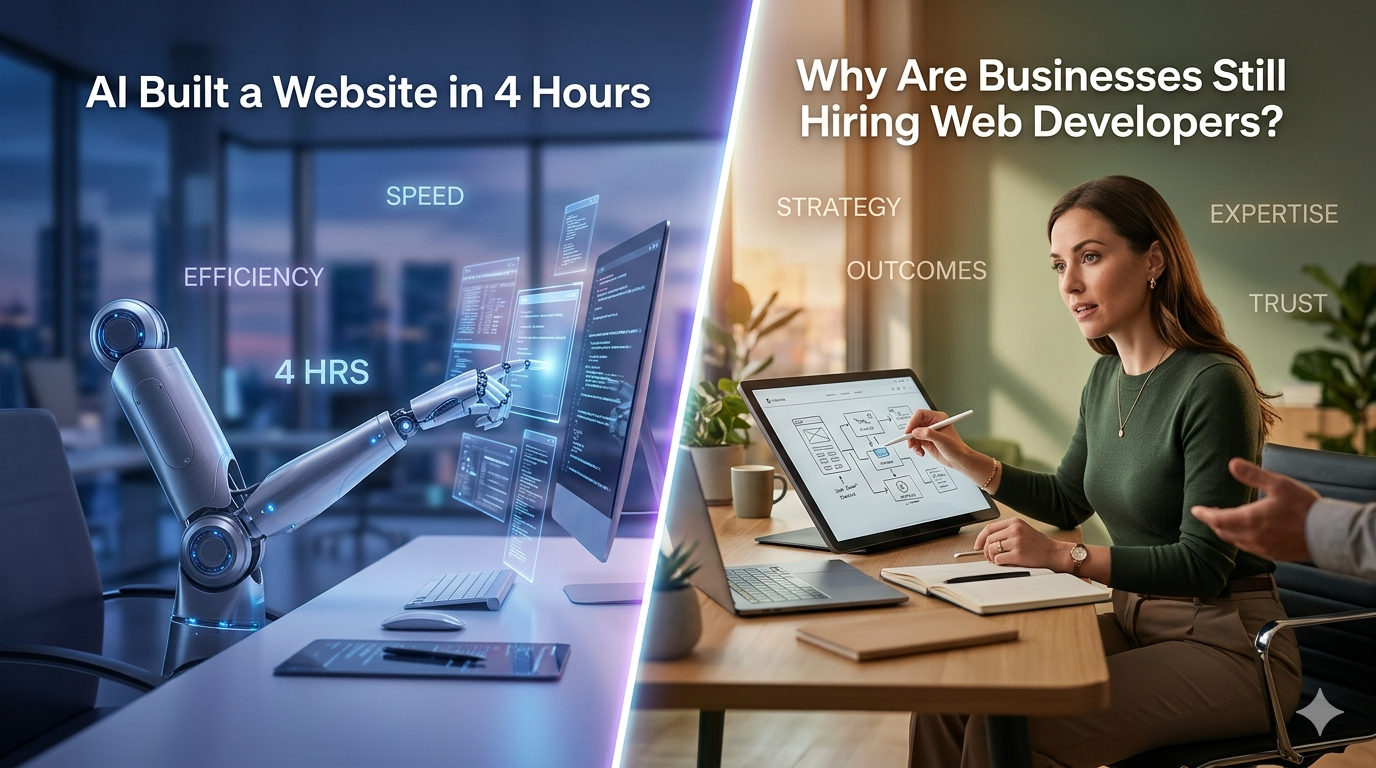
A few years ago, the idea of building a website in just a few hours sounded unrealistic. Businesses often spent weeks planning layouts, writing content, reviewing designs, and coordinating with developers before a website was ready to launch.
Today, the process looks very different.
AI-powered tools can generate landing pages, write website copy, create layouts, suggest images, and even produce working code in a fraction of the time. In some cases, a business owner can describe their company in a few sentences and receive a functional website before lunch.
From the outside, this raises an obvious question:
If AI can build a website in four hours, why are businesses still paying web developers?
The answer is simple. Most businesses are not paying for a website. They are paying for outcomes.
A website is only one part of the equation. Generating a collection of pages is relatively easy. Creating a website that attracts visitors, builds trust, converts customers, and supports business growth is a much more complex challenge.
This difference explains why businesses continue investing in developers, designers, and digital experts even as AI tools become more powerful.
The Website Was Built Quickly. The Business Problem Wasn’t Solved.
One of the biggest misconceptions about AI website builders is that completing a website means completing the project.
In reality, launching a website is often the beginning of the process rather than the end.
Many businesses discover that their new AI-generated website looks professional but does not produce meaningful results. Traffic remains low, leads fail to appear, and customer engagement does not improve.
This happens because a website is not valuable simply because it exists.
A website must support a business objective.
For some companies, that objective is generating leads. For others, it may be selling products, booking appointments, building authority, or educating customers. Without a strategy behind the website, even a perfectly functional design can fail to deliver results.
AI can generate pages quickly, but it cannot automatically understand a company’s goals, audience behavior, competitive landscape, or growth strategy.
Most Websites Don’t Fail Because of Design
Many business owners assume outdated designs cause poor results.
In reality, most websites fail because they solve the wrong problem.
A modern-looking homepage means very little if visitors cannot understand what the business does, why it is different, or what action they should take next.Professional developers spend significant time thinking about user journeys, navigation structures, conversion paths, and content organization.
These decisions influence how visitors interact with a website.
AI can generate a layout, but it cannot always determine whether that layout supports the unique needs of a specific business.
The difference may seem small, but it often determines whether a website generates revenue or simply exists online.
AI Can Generate Content. It Cannot Create Expertise.
Most AI website builders include content-generation features.
Within minutes, businesses can generate service descriptions, company introductions, product explanations, and call-to-action sections.
The challenge is that many businesses are using the same tools and receiving similar outputs.
As a result, websites often begin sounding alike.
Generic phrases such as “innovative solutions,” “customer-focused approach,” and “industry-leading services” appear repeatedly across AI-generated websites.
Visitors notice this.
Trust is built through specificity, expertise, and authenticity.
Customers want to know why a company is different, how it solves problems, and what experience it brings to the table.
These insights typically come from real-world knowledge, customer interactions, and industry experience—not from a prompt.
The Hidden Cost of Fast Websites
Speed is one of AI’s greatest strengths.
However, speed can sometimes create new challenges.
When businesses launch websites quickly, they often skip important planning stages.
Questions such as:
- Who is the target audience?
- What are the primary conversion goals?
- Which pages are necessary?
- What keywords should be targeted?
- How will success be measured?
are sometimes overlooked.
Without clear answers, businesses risk launching websites that look complete but lack direction.
The result is often frustration.
The website exists.
The business invested time and money.
But the expected growth never arrives.
Developers frequently become involved at this stage, not to rebuild the website from scratch, but to solve problems that were never addressed during the initial build process.
Why Businesses Still Pay for Strategy
A growing number of business owners are realizing that the most valuable part of web development is not coding.
It is decision-making.
Successful websites are built around dozens of strategic choices.
What content should appear above the fold?
Which call-to-action should receive the most attention?
How should services be organized?
What information matters most to potential customers?
How can friction be reduced during the buying process?
These decisions require an understanding of customer behavior, business goals, and market conditions.
AI can provide suggestions.
Developers and strategists provide judgment.
That distinction becomes increasingly important as websites become easier to generate.
SEO Is More Than Publishing Pages
Another common misconception is that launching a website automatically creates visibility.
In reality, even the most attractive website is unlikely to generate traffic without a strong SEO foundation.
Search engines evaluate hundreds of factors when determining rankings.
Website structure, internal linking, page speed, content quality, user experience, search intent, and topical authority all influence performance.
AI can help create content and organize information.
However, effective SEO requires continuous analysis and adaptation.
Businesses that rely solely on automated website generation often discover that traffic growth is far more difficult than website creation.
This is another reason developers and SEO specialists continue to play a critical role.
Custom Problems Require Custom Solutions
Many businesses eventually encounter challenges that generic templates cannot solve.
An e-commerce company may need advanced product filtering.
A service business may require custom booking systems.
A SaaS company may need unique user dashboards.
A healthcare provider may have strict compliance requirements.
These situations require tailored solutions.
AI is excellent at producing common patterns because it learns from existing examples.
Custom business requirements often fall outside those patterns.
Developers bridge this gap by creating solutions tailored to specific business needs rather than relying on generic assumptions.
The Value of Human Judgment
The conversation about AI often focuses on what technology can build.
A more important question is what technology can understand.
Successful websites are built around people.
People make decisions based on emotions, trust, expectations, and experiences.
Understanding these factors requires context.
A developer working closely with a business can identify opportunities, anticipate challenges, and recommend improvements based on real-world objectives.
AI can generate options.
Humans decide which option makes sense.
That role remains incredibly valuable.
The Future of Web Development Is Not AI vs Developers
The discussion is often framed as a competition.
Will AI replace developers?
Will businesses stop hiring web professionals?
The evidence suggests a different future.
AI is becoming a powerful tool that helps developers work faster, automate repetitive tasks, and focus on higher-value activities.
Businesses are not choosing between AI and developers.
They are increasingly using both.
The most successful projects combine AI efficiency with human expertise.
AI accelerates execution.
Developers provide strategy, problem-solving, creativity, and judgment.
Together, they create better outcomes than either could achieve alone.
Final Thoughts
AI can build a website in four hours.
That is impressive.
But businesses are not hiring developers because they need pages, layouts, or code. They are hiring developers because they need results.
A website that generates leads, builds trust, supports growth, and solves business problems requires far more than automation.
As website creation becomes easier, the value of expertise becomes more apparent, not less.
The businesses that succeed in the AI era will not be the ones that build websites the fastest. They will be the ones that combine technology with strategy, creativity, and a deep understanding of their customers.
In the end, AI can build a website.
But building a successful online business still requires people.
Frequently Asked Questions
Can AI completely replace web developers?
AI can automate many development tasks, but businesses still need developers for strategy, custom functionality, user experience, security, and long-term website growth.
Are AI website builders good for small businesses?
AI website builders can be a great starting point for small businesses looking to launch quickly. However, customization and strategic planning are often needed to achieve better results.
Why do businesses still hire developers if AI can build websites?
Businesses hire developers because websites need more than code. They require planning, optimization, problem-solving, and ongoing improvements that align with business goals.
Is AI-generated web content good for SEO?
AI-generated content can support SEO efforts, but it should be reviewed, improved, and combined with original expertise to provide real value to users.
What is the biggest limitation of AI website builders?
Their biggest limitation is understanding business context. AI can generate websites, but it cannot fully understand customer behavior, brand positioning, or long-term business objectives.